

 Version 2025.2.0 of pyMOR has been released. More information at pymor.org.
 At its workshop this year, the Expert Committee 2.13 "Modeling, Identification and Simulation in Automation Technology" of the VDI/VDE Society for Measurement and Automation Technology re-elected Dr. Jens Saak as its head. Moreover apl. Prof. Dr. Jörg Fehr (Uni Stuttgart) was elected as co-head. They will lead the expert committee together for the upcoming three years.Version 2025.1.2 of pyMOR has been released. More information at pymor.org.Version 2025.1.1 of pyMOR has been released. More information at pymor.org.
 The international association for Applied Mathematics and Mechanics set up a new activity group on research software engineering and research data management in mathematics and mechanics at this year's general assembly. This was in response to a proposal by Jens Saak (CSC), Robert Speck (FZ Jülich) and Jan Philipp Thiele (TU Braunschweig). The constituent workshop is planned for the end of the year. Exact dates are currently being determined in a survey among the founding members.
 Version 3.1 of the M-M.E.S.S. toolbox for MATLAB and GNU Octave has been released. It contains various corrections and usability improvements..Version 2024.2.0 of pyMOR has been released. More information at pymor.org.
 With the second "MaRDI (Mathematical Research Data Initiative within the National Research Data Infrastructure of Germany) Workshop on Scientific Computing", we aim to bring together researchers from the Scientific Computing community and related disciplines, who are interested in the FAIRness of their research data. Apart from presentations on the current MaRDI projects and selected keynote talks, we will leave generous room for discussions. Further, we invite participants to contribute talks related to the following topics: Knowledge graphs and ontologies; Research Software (Engineering/Interfaces/Management); Benchmarks; Formal workflow descriptions; Reproduction of numerical experiments; Research data management.Version 2024.1.1 of pyMOR has been released. More information at pymor.org.Version 2024.1.0 of pyMOR has been released. More information at pymor.org.This year's pyMOR School will be held at Uni Münster from Monday 26h till Friday 30th of August.Version 2023.2.0 of pyMOR has been released. More information at pymor.org.
 MORLAB - Model Order Reduction LABoratory version 6.0 for model reduction of linear systems has been released. More information at: http://www.mpi-magdeburg.mpg.de/projects/morlabVersion 3.0 of the M-M.E.S.S. toolbox for MATLAB and GNU Octave has been released. It introduces Krylov subspace projection solvers for Lypaunov and Riccati equations, the first Sylvester equation solver and a new logging tool..This year's pyMOR School will be held at TU Berlin from Monday 18th till Friday 22nd of September.Version 2023.1.0 of pyMOR has been released. More information at pymor.org.Version 2022.2.1 of pyMOR has been released. More information at pymor.org.Version 2022.2.0 of pyMOR has been released. More information at pymor.org.At its workshop this year, the Expert Committee 1.30 "Modeling, Identification and Simulation in Automation Technology" of the VDI/VDE Society for Measurement and Automation Technology elected Dr. Jens Saak as its new head. He takes office with immediate effect.Version 2022.1.1 of pyMOR has been released. More information at pymor.org.This year's pyMOR School will be held at our MPI from Monday 22nd till Friday 26th of August.Version 2022.1.0 of pyMOR has been released. More information at pymor.org.With this first MaRDI Workshop on Scientific Computing, we want to bring together researchers from the Scientific Computing community and related disciplines who are interested in the FAIRness of their research data. Apart from presentations on the current MaRDI projects and selected keynote talks, birds-of-a-feather sessions will leave room for discussions and hands-on tutorials.
 This workshop aims to provide a coherent set of lectures that will adequately clarify the mathematical aspects of the (optimal) control of dynamical systems, with special emphasis on model reduction methods for large-scale systems and optimization. Due to the funding by the DAAD project “Accelerated solution of optimal damping problems”, a special focus lies on these specific problems.Version 2.2 of M-M.E.S.S. has been released. It is mostly a bugfix version with significantly revised documentation in places..Version 2021.2.0 of pyMOR has been released. More information at pymor.org.This year's pyMOR School will be held at the WWU Münster from Monday 4th till Friday 8th of October.Version 2021.1.0 of pyMOR has been released. More information at pymor.org.
 CSC Team Leader Dr. Jens Saak has been appointed member of the editorial board of the Journal "Mathematical and Computational Applications".
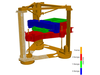 Thermal effects are the most dominant source for displacements in machine tools and thus work-piece
inaccuracies during the manufacturing process. A promising strategy to meet the ever-increasing accuracy requirements is the use of predictive models for, e.g., parameter and design optimizations or online
correction of the thermally induced error at the tool center point (TCP) in the production process. However,
these techniques require fast but precise simulations. The need for high model accuracy is in direct contrast to the desired real-time capabilities. Model order reduction (MOR) is an attractive tool to overcome
this problem. A modeling toolchain, which is tailored for the effective construction of fast and accurate
models is proposed and demonstrated, emphasizing the involved MOR step.Version 2020.2.2 of pyMOR has been released. More information at pymor.org.
Thermal effects are the most dominant source for displacements in machine tools and thus work-piece
inaccuracies during the manufacturing process. A promising strategy to meet the ever-increasing accuracy requirements is the use of predictive models for, e.g., parameter and design optimizations or online
correction of the thermally induced error at the tool center point (TCP) in the production process. However,
these techniques require fast but precise simulations. The need for high model accuracy is in direct contrast to the desired real-time capabilities. Model order reduction (MOR) is an attractive tool to overcome
this problem. A modeling toolchain, which is tailored for the effective construction of fast and accurate
models is proposed and demonstrated, emphasizing the involved MOR step.Version 2020.2.2 of pyMOR has been released. More information at pymor.org.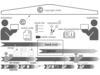 This paper by J. Fehr (Uni Stuttgart), C. Himpe (CSC), S. Rave (WWU Münster) and J. Saak (CSC) intends to be a bottom-up approach for sustainable hand-over processes in scientific software development from a developer’s perspective. It got published in the Journal of Open Research Software today.The M.E.S.S. development team releases version 2.1 of the MATLAB and OCTAVE toolbox. The new version contains further improvements to the MOR functions, as well as various minor bug fixes. Most importantly, this version provides new solvers for Lyapunov-plus-positive equations and support for the new sparss and mechss system classes in Matlab
 In this manuscript, Manuela Hund, Tim Mitchell, Petar Mlinarić, and Jens Saak, propose an H2⊗L2-optimal model order reduction method for parametric linear time-invariant systems. This is the first system-theoretic parametric model order reduction method performing locally optimal approximation in an appropriate system norm, while, at the same time, allowing a broad class of parametric reduced-order models and making only mild assumptions on the full-order model. The new optimization-based algorithm moves beyond classic projection-based approaches and guarantees uniform stability of the computed reduced-order models. The preprint is available on arXiv.
 Dr. Jens Saak (CSC - DISC)and Prof. Zoran Tomljanovic (J.J. Strossmayer University of Osijek) have successfully applied for a project on accelerated solution of optimal damping problems. The DAAD supports the exchange of scientists from Magdeburg, Osijek and Zagreb in the framework of the program of project-related exchange of persons (Croatia 2021-2023) for the upcoming two years.
 Merging the forces of the Scientific Computing team and the CSC IT infrastructure team, DISC combines the knowledge about hardware and software putting the synergies to practice for the next generation HPC solutions of the CSC department.Version 2020.2.0 of pyMOR has been released. More information at pymor.org.
 The pyMOR Online Course 2020 (replacing the pyMOR School) will be held from Monday, September 28, till Friday, October 2, 2020.Version 2020.1.2 of pyMOR has been released. More information at pymor.org.Version 2020.1.1 of pyMOR has been released. More information at pymor.org.
 Together with Dirk Wolfram (nee Siebelts, CAU Kiel), Jens Saak and Steffen W. R. Werner have been awarded best paper in the category applications of the journal at-Automatisierungstechnik in the year 2019 for their contribution "A comparison of second-order model order reduction methods for an artificial fishtail".The M.E.S.S. developers team has released version 2.0.1 of their MATLAB and OCTAVE package. The new version features minor improvements in the MOR functions, as well as some bug fixes for the DAE_1 function handles and DRE solvers.
 This workshop is the eighth in a series of workshops on matrix equations and tensor techniques. As in the previous meetings, the focus will be on the latest developments in the theory, computation and applications of linear and nonlinear matrix equations and tensor equations.
 The Scientific Computing Team of the Computational Methods in Systems and Control Theory group at the MPI in Magdeburg is holding the third workshop entitled "Power-Aware Computing - PACO2019" at the Max Planck Institute Magdeburg, Germany. The workshop aims at bringing together experts in and close to the field in a 2-day event.
 The first ever pyMOR School will be held at the MPI Magdeburg in October 2019 from Monday 7th till Friday 11th.The M.E.S.S. developers team has released version 2.0 of the MATLAB and OCTAVE package. The new version features several new solvers, some usability and efficiency improvements as well as various smaller bug fixes.
 The M-M.E.S.S. toolbox for Matlab is getting reinforcements. In version 1.0.0 today the C-based implementation with bindings for python and Matlab (via MEX) has been released. As of today, the C version does not support solvers for differential matrix equations, but comes with a couple of features, that are still missing in M-M.E.S.S..
 This years Meeting of the GAMM activity group on applied and numerical linear algebra on September 07 and 08 in Cologne features the topic HPC. Martin Köhler and Jens Saak represented the work of the CSC group in a topical session on hybrid CPU-GPU implementations of algorithms from linear algebra.
 The second Workshop on PowerAware Computing is taking place at the Max Planck conference center at Ringberg castle at the Tegernsee lake. The topics have been slightly broadened as compared to the previous instance in 2015. We have found a number of well established keynote and invited speakers.
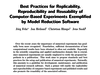 The final version of the manuscript has now been published open-access in AIMS Mathematics.
 Jens Saak and Martin Köhler will give a talk „Formeln für die Energiewende: Wie kann mit Mathematik Energie gespart werden?" within the series "Wissenschaft im Rathaus". Beginning: 7 pm. Venue: Altes Rathaus, Magdeburg.The 16th GAMM Workshop Applied and Numerical Linear Algebra took place at the Hamburg UT. Peter Benner, Jens Saak, Nicodemus Banagaaya, Patrick Kürschner and Martin Stoll from the CSC / NDS group attended. Martin Stoll, Jens Saak and Patrick Kürschner presented recent result in contributed talks.
 The CSC group is presenting talks by Pawan Goyal, Jan Heiland and Alexander Zuyev. Moreover, Jens Saak organizes a Minisymposium on Matrix Equations: Solvers and Applications in cooperation with Hermann Mena.
 CSC and NDS contributed several talks (Peter Benner, Jens Saak, Patrick Kürschner, Akwum Onwunta, Martin Soll, Christian Himpe, Xin Liang) to minisymposia at this year's ILAS Conference with 440 participants at KU Leuven. Furthermore, Peter Benner co-organized the invited minisymposium "Matrix Equations" jointly with Beatrice Meini (U Pisa).Reproducible and replicable numerical experiments are the basic requirement for the comparability of different methods on common benchmark examples. This article by J.Fehr, J. Heiland, Ch. Himpe and J. Saak introduces the general topic, gives guidelines for good practice in the execution of such experiments in the area of model order reduction and explains basic requirements on the underlying software for its reusability in similar use cases.The M.E.S.S. developers team has released version 1.0 of the LyaPack successor after a development time of alomst 8 years.
 Norman Lang, Jens Saak and Tatjana Stykel present a practically realizable implementation of the balanced truncation method for linear time-varying systems in terms of a differential Lyapunov equation solver based on a symmetric indefinite factorization of the solution.Peter Benner, Zvonimir, Bujanovic, Patrick Kürschner and Jens Saak present a quadratic version of the ADI iteration for directly handling large-scale algebraic Riccati equations.
 The fifth workshop on matrix equations and tensor techniques is held in Bologna, Italy from September 21-22, 2015. It is coorganized by the CSC group. Sergey Dolgov is a keynote speaker and Jens Saak, Heiko Weichelt, Patrick Kürschner will give contributed talks.
 The article Towards the identification of heat induction in chip removing processes via an optimal control approach has been published in Volume 9, Issue 3 of the journal Production Engineering Research and Development. It covers a numerical method based on an optimal control ansatz for the solution of inverse heat conduction problems.
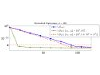 Peter Benner, Patrick Kürschner und Jens Saak present in this work computational approaches for an numerically efficient execution of frequency-limited balanced trunction for large-scale systems.Inside the project EHFARS the Scientific Computing Team is holding their initiation workshop entitled "Power-Aware Computing PACO2015" at the MPI. The workshop aims at bringing German experts in the field and our project partners from Uruguay together in a 3 day event from July 6 to 08.Peter Benner, Matthias Heinkenschloss, Jens Saak, and Heiko Weichelt combine in this preprint various methods to effciently solve large-scale algebraic Riccati equations.
 The recently published article Riccati-based
Boundary Feedback Stabilization of Incompressible Navier-Stokes
Flows appeared in the 2nd issue of the 37th SISC volume on
pages A832-A858. The article describes efficient numerical methods
to compute a Riccati based feedback stabilization via boundary
control input for incompressible Navier-Stokes equations.
The recently published article Riccati-based
Boundary Feedback Stabilization of Incompressible Navier-Stokes
Flows appeared in the 2nd issue of the 37th SISC volume on
pages A832-A858. The article describes efficient numerical methods
to compute a Riccati based feedback stabilization via boundary
control input for incompressible Navier-Stokes equations. The article On the benefits of the LDLT factorization for large-scale differential matrix equation solvers will appear in volume 480 of the Elsevier journal Linear Algebra and its Applications. It covers efficient numerical methods for the solution of differential matrix equations.The article Towards the identification of heat induction in chip removing processes via an optimal control approach will appear in the journal Production Engineering Research and Development. It covers a numerical method based on an optimal control ansatz for the solution of inverse heat conduction problems.
 The power-aware HPC task force of the CSC group is supported by the federal ministry for science and education for a period of two years. With the help of the strategies of the German government for the internationalization of science and research we receive an amount of almost 40 000€ for travel and workshop expenses.
 The book chapter Optimal Control-Based Feedback
Stabilization of Multi-field Flow Problems appeared in the Springer book
Trends in PDE Constrained Optimization in the series
International
Series of Numerical Mathematics as volume 165 on the pages 173-188.Peter Benner, Patrick Kürschner and Jens Saak discuss a numerical algorithm for solving large-scale, nonsymmetric algebraic Ricatti equations, which combines a Newton's method with the low-rank ADI iteration for Sylvester equations.Peter Benner, Jens Saak and M. Monir Uddin combine an approach for Balanced truncation of unstable systems with the efficient treatment of Stokes-like index-2 DAE structures and the latest techniques for implementing the low-rank ADI as well as choosing appropriate ADI shifts.Martin Köhler und Jens Saak have extended the already optimized methods for the solution of matrix Lyapunov equations with (quasi) triangular coefficient matrices to support accelerator devices. Thus, they have shown the main problems of using an accelerator device in the Bartels-Stewart algorithm and presented mathematical solutions for these problems.Peter Benner, Jonas Denißen, Patrick Kürschner and Jens Saak attend the workshop within the DAAD project Optimal Damping of Vibrating Systems in Osijek (Croatia). The workshop is supported by the German Academic Exchange Service (DAAD), Zeidler-Forschungs-Stiftung and the department of mathematics, J. J. Strossmayer University of Osijek.This years second meeting of the GAMM activity group on "Dynamics and Control" will take place together with the GMA activity groups 1.30 and 1.40 as usual on a bi-anual basis. The meeting is scheduled September 22 to 26 at the Momentum hotel Anif near Salzburg. The talks of the GAMM activity group will take place on Wednesday 24th and contain contributions by Peter Benner and Norman Lang. Also Jens Saak gives a talk in the GMA activity group 1.30 on Friday September 26.Martin Köhler und Jens Saak have extended existing methods for the solution of matrix Lyapunov equations with (quasi) triangular coefficient matrices from Blas level-2 to level-3. Thus, they have optimized the exploitation of modern computer architectures and achieved acceleration of the execution by notable factors.The article "Model Order Reduction for Systems with Moving Loads" by Peter Benner, Norman Lang and Jens Saak has been published at June 28 2014, in De Gruyter Oldenbourg: at-Automatisierungstechnik: volume 62 (7).
The book chapter Optimal Control-Based Feedback
Stabilization of Multi-field Flow Problems appeared in the Springer book
Trends in PDE Constrained Optimization in the series
International
Series of Numerical Mathematics as volume 165 on the pages 173-188.Peter Benner, Patrick Kürschner and Jens Saak discuss a numerical algorithm for solving large-scale, nonsymmetric algebraic Ricatti equations, which combines a Newton's method with the low-rank ADI iteration for Sylvester equations.Peter Benner, Jens Saak and M. Monir Uddin combine an approach for Balanced truncation of unstable systems with the efficient treatment of Stokes-like index-2 DAE structures and the latest techniques for implementing the low-rank ADI as well as choosing appropriate ADI shifts.Martin Köhler und Jens Saak have extended the already optimized methods for the solution of matrix Lyapunov equations with (quasi) triangular coefficient matrices to support accelerator devices. Thus, they have shown the main problems of using an accelerator device in the Bartels-Stewart algorithm and presented mathematical solutions for these problems.Peter Benner, Jonas Denißen, Patrick Kürschner and Jens Saak attend the workshop within the DAAD project Optimal Damping of Vibrating Systems in Osijek (Croatia). The workshop is supported by the German Academic Exchange Service (DAAD), Zeidler-Forschungs-Stiftung and the department of mathematics, J. J. Strossmayer University of Osijek.This years second meeting of the GAMM activity group on "Dynamics and Control" will take place together with the GMA activity groups 1.30 and 1.40 as usual on a bi-anual basis. The meeting is scheduled September 22 to 26 at the Momentum hotel Anif near Salzburg. The talks of the GAMM activity group will take place on Wednesday 24th and contain contributions by Peter Benner and Norman Lang. Also Jens Saak gives a talk in the GMA activity group 1.30 on Friday September 26.Martin Köhler und Jens Saak have extended existing methods for the solution of matrix Lyapunov equations with (quasi) triangular coefficient matrices from Blas level-2 to level-3. Thus, they have optimized the exploitation of modern computer architectures and achieved acceleration of the execution by notable factors.The article "Model Order Reduction for Systems with Moving Loads" by Peter Benner, Norman Lang and Jens Saak has been published at June 28 2014, in De Gruyter Oldenbourg: at-Automatisierungstechnik: volume 62 (7). Norman Lang, Hermann Mena, and Jens Saak present an LDLT based version of the standard low-rank Lyapunov solvers based on ADI or Krylov subspace methods. The method allows us to avoid complex arithmetic for the solution of matrix differential equations via higher order time integration methods, as well as the a priori reduction of the number of columns in the right hand side of the arising algebraic Lyapunov equations inside of the time integration loop.Patrick Kürschner and Jens Saak presented their
respective latest results on the efficient computation of frequency
limited Gramain matrices and inexact Newton based solution of the
LQR problem for linearized flow problems at the joint meeting of the
GAMM ANLA and its spanish counterpart ALAMA that took place in Barcelona July 14-16. Peter Benner acted as part of the organizing commitee.Martin Köhler and Jens Saak participate at the 8th International Workshop on Parallel Matrix Algorithms and Applications (PMAA14) from 2nd to 4th July 2014 in Lugano. Martin Köhler presented a new efficient implementation of the Bartels-Stewart Algorithm for the solution of dense generalized Lyapunov equations. Our software library FlexiBLAS was presented by Jens Saak.The 85th Annual Meeting of the International
Association of Applied Mathematics and Mechanics is taking place in
Erlangen, Germany. Patrick Kürschner, Jens Saak, Jonas
Denißen, Norman Lang, Akwum Onwunta, Björn Baran, Ulrike Baur,
Zvonimir Bujanovic, Jan Heiland, Martin Köhler, Matthias Voigt, and Sara Grundel will give talks in the contributed sections.
Norman Lang, Hermann Mena, and Jens Saak present an LDLT based version of the standard low-rank Lyapunov solvers based on ADI or Krylov subspace methods. The method allows us to avoid complex arithmetic for the solution of matrix differential equations via higher order time integration methods, as well as the a priori reduction of the number of columns in the right hand side of the arising algebraic Lyapunov equations inside of the time integration loop.Patrick Kürschner and Jens Saak presented their
respective latest results on the efficient computation of frequency
limited Gramain matrices and inexact Newton based solution of the
LQR problem for linearized flow problems at the joint meeting of the
GAMM ANLA and its spanish counterpart ALAMA that took place in Barcelona July 14-16. Peter Benner acted as part of the organizing commitee.Martin Köhler and Jens Saak participate at the 8th International Workshop on Parallel Matrix Algorithms and Applications (PMAA14) from 2nd to 4th July 2014 in Lugano. Martin Köhler presented a new efficient implementation of the Bartels-Stewart Algorithm for the solution of dense generalized Lyapunov equations. Our software library FlexiBLAS was presented by Jens Saak.The 85th Annual Meeting of the International
Association of Applied Mathematics and Mechanics is taking place in
Erlangen, Germany. Patrick Kürschner, Jens Saak, Jonas
Denißen, Norman Lang, Akwum Onwunta, Björn Baran, Ulrike Baur,
Zvonimir Bujanovic, Jan Heiland, Martin Köhler, Matthias Voigt, and Sara Grundel will give talks in the contributed sections. Martin Köhler and Jens Saak publish LAPACK Working Note #284 on a plugin based BLAS implementation that allows to switch the BLAS library used by a program at runtime without the need for recompilation or the requirement for any super user privileges.
 On December 10-th 2013 Björn Baran will defend his Bachelor thesis by the topic "Numerisches Lösen großer dünnbesetzter Matrixgleichungen in Python". The colloquium will be held in English language. It starts 13:30 in the Seminar room Prigogine at the MPI.
 The M.E.S.S. software suite is the successor of the obsolete LyaPack MATLAB® toolbox for solving large scale matrix equations and related problems. The software suite consists of a new MATLAB toolbox and a separate C library C-M.E.S.S. which works independent from MATLAB. Due to the fact that many scientists use Python with NumPy and SciPy for their everyday work we want to provide the key algorithm of M.E.S.S. for them, too. In this report Björn Baran, Martin Köhler, Nitin Prasad and Jens Saak describe how to build an interface between Python and C-M.E.S.S. on top of the NumPy/SciPy-Python libraries.
 The third colloquium of the SFB/TR-96 takes place in Aachen from 29th to 30th of october. For further informations have a look at the official webpage of the SFB/TR-96 The authors present novel shift strategies for low-rank
ADI methods for the numerical solution of large-scale Lyapunov and Sylvester
equations. In the proposed approaches shift parameters are computed
automatically during the ADI iteration. Numerical test show that these new
shifts outperform existing strategies in several cases, especially for problems
with complex spectra.This paper presents the results obtained within the SPP1253 project: Optimal Control-Based Feedback Stabilization in Multi-Field Flow Problems .Norman Lang, Jens Saak und Matthias Voigt present parts of their research results at the GMA activity group 1.30 from September 18 to September 20 at the Momentum hotel in Anif (Salzburg).The GAMM Workshop Applied and Numerical Linear Algebra will take place at the Bergische Universität Wuppertal from 09/09 - 09/10/2013. Peter Benner, Matthias Voigt, Jens Saak, Jessica Bosch und Patrick Kürschner are participants and in part give contributed talks.Efficient numerical algorithms for the solution of large and sparse matrix Riccati and Lyapunov equations based on the low rank alternating directions implicit (ADI) iteration have become available around the year 2000. Over the decade that passed since then, additional methods based on extended and rational Krylov subspace projection have entered the field and proved to be competitive alternatives. In this survey we sketch both types of methods and discuss their advantages and drawbacks. We focus on the continuous time case here, but corresponding results for discrete time problems can for most results be found in the available literature and will be referred to throughout the paper. On April 1st Björn Baran started as a new student research assistant in the M.E.S.S. project. His main duties will be the implementation of recent algorithmic advances in the Matlab version. In his Bachelor thesis he will then port these new codes to Python and compare this implementation with simple python interface functions to the C version of M.E.S.S.The 84th Annual Meeting of the International Association of Applied Mathematics and Mechanics is taking place in Novi Sad, Serbia. Peter Benner, Tobias Breiten, Patrick Kürschner, Jessica Bosch, Jens Saak, Martin Redmann, Jonas Denißen and Norman Lang will give talks in the contributed sections.The final meeting of the DFG SPP1253 Optimization with Partial Differential Equations was held at Banz monastery. Peter Benner, Heiko Weichelt and Jens Saak participated and presented the latest results of the local project Optimal Control-Based Feedback Stabilization of Multi-Field Flow Problems there. (Talk ca. 16MB as PDF)
The third colloquium of the SFB/TR-96 takes place in Aachen from 29th to 30th of october. For further informations have a look at the official webpage of the SFB/TR-96 The authors present novel shift strategies for low-rank
ADI methods for the numerical solution of large-scale Lyapunov and Sylvester
equations. In the proposed approaches shift parameters are computed
automatically during the ADI iteration. Numerical test show that these new
shifts outperform existing strategies in several cases, especially for problems
with complex spectra.This paper presents the results obtained within the SPP1253 project: Optimal Control-Based Feedback Stabilization in Multi-Field Flow Problems .Norman Lang, Jens Saak und Matthias Voigt present parts of their research results at the GMA activity group 1.30 from September 18 to September 20 at the Momentum hotel in Anif (Salzburg).The GAMM Workshop Applied and Numerical Linear Algebra will take place at the Bergische Universität Wuppertal from 09/09 - 09/10/2013. Peter Benner, Matthias Voigt, Jens Saak, Jessica Bosch und Patrick Kürschner are participants and in part give contributed talks.Efficient numerical algorithms for the solution of large and sparse matrix Riccati and Lyapunov equations based on the low rank alternating directions implicit (ADI) iteration have become available around the year 2000. Over the decade that passed since then, additional methods based on extended and rational Krylov subspace projection have entered the field and proved to be competitive alternatives. In this survey we sketch both types of methods and discuss their advantages and drawbacks. We focus on the continuous time case here, but corresponding results for discrete time problems can for most results be found in the available literature and will be referred to throughout the paper. On April 1st Björn Baran started as a new student research assistant in the M.E.S.S. project. His main duties will be the implementation of recent algorithmic advances in the Matlab version. In his Bachelor thesis he will then port these new codes to Python and compare this implementation with simple python interface functions to the C version of M.E.S.S.The 84th Annual Meeting of the International Association of Applied Mathematics and Mechanics is taking place in Novi Sad, Serbia. Peter Benner, Tobias Breiten, Patrick Kürschner, Jessica Bosch, Jens Saak, Martin Redmann, Jonas Denißen and Norman Lang will give talks in the contributed sections.The final meeting of the DFG SPP1253 Optimization with Partial Differential Equations was held at Banz monastery. Peter Benner, Heiko Weichelt and Jens Saak participated and presented the latest results of the local project Optimal Control-Based Feedback Stabilization of Multi-Field Flow Problems there. (Talk ca. 16MB as PDF)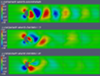 First forward simulation with integrated feedback stabilization available.
 On this years Elgersburg Workshop the Computational Methods in Systems and Control Theory is presenting three talks by P. Benner, M. Redmann and M.Voigt. Additionally, U. Baur, T. Breiten, J. Denißen and J. Saak are participating.Sandra Kutz (student of applied mathematics at OvGU) is investigating the capabilities and limitations of Matlabs GPU computing toolbox in the context of solvers for large and sparse matrix equations during a 5 week internship.A meeting of the working group parameterization and simulation of the SFB/TR-96 takes place in Dresden from 31st of January to 1st of February. For further informations have a look at the official webpage of the SFB/TR-96 Model order recuction using balanced truncation for differential algebraic second order systems in M.E.S.S.Numerical Solution of large and sparse matrix equations on distributed memory parallel machinesApproximate solution of the Linear systems of equations in the ADI Method for large and sparse matrix equationsA CG-Method with ADI preconditioning for the solution of large sparse Lyapunov equations with symmetric coefficient matricesStep size control for the numerical solution of large and sparse matrix differential Riccati equationsThe article Computation of a Compact State Space Model for an Adaptive Spindle Head Configuration with Piezo Actuators using Balanced Truncation will appear in volume 6 issue 6 of the Springer journal Production Engineering Research and Development. It covers efficient numerical methods for the model order reduction of the resulting index 1 differential algebraic systems via balanced truncation.We consider balanced truncation model order reduction for symmetric second order systems. The occurring large-scale generalized and structured Lyapunov equations are solved with a specially adapted low-rank ADI type method. Stopping criteria for this iteration are investigated and a new result concerning the Lyapunov residual within the low-rank ADI method is established. We also propose a goal oriented stopping criterion which tries to incorporate the balanced truncation approach already during the ADI iteration. The model reduction approach using the ADI method with different stopping criteria is evaluated on several test systems.The second colloquium of the SFB/TR-96 takes place at Fraunhofer IWU in Chemnitz from 24th to 25th of october. For further informations have a look at the official webpage of the SFB/TR-96
 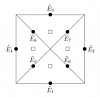 The authors show a method for boundary feedback stabilization of the Stokes around a stationary trajectory using a new non-conforming
finite element method that represents the action of the Leray projection pointwise locally.
The authors show a method for boundary feedback stabilization of the Stokes around a stationary trajectory using a new non-conforming
finite element method that represents the action of the Leray projection pointwise locally. The Chemitz FEM Symposium is celebrating a triple jubilee this year. At the 25th symposium Arnd Meyer and Ulrich Langer are celebrating their 60th birthdays. The CSC group is congratulating and sends Peter Benner, Jens Saak(poster presentation) and Piotr Skrzypacz (talk) to participate in the event.This years second meeting of the GAMM activity group on "Dynamics and Control" will take place together with the GMA activity groups 1.30 and 1.40 as usual on a bi-anual basis. The meeting is scheduled September 17 to 21 at Sporthotel Anif near Salzburg. The talks of the GAMM activity group will take place on Wednesday 19th and contain contributions by Patrick Kürschner, Jens Saak and M. Monir Uddin. Also Matthias Voigt is participating as member of the activity group.Peter Benner, Jens Saak und Martin Stoll are visiting the kick-off meeting of GAMM activity group Computational Science and Engineering (CSE) in Garching on September 17th and 18th.From September 2nd to 5th the 12th GAMM Workshop on Applied and Numerical Linear Algebra is taking place on Chateau Liblice in Czech Republic. The CSC group will give talks by Jens Saak, Kapil Ahuja, and Heiko Weichelt.
 The Linux cluster This paper presents the results obtained within the SPP1253 project: Optimal Control-Based Feedback Stabilization in Multi-Field Flow Problems .
 From June 18th to 22nd the SIAM Applied Linear Algebra conference 2012 is taking place in Valencia (Spain). The Computational Methods in Systems and Control Theory group is organizing two Minisymposia (Jens Saak and Martin Stoll) there. Moreover the group presents five invited Minisymposium talks (Peter Benner, Kapil Ahuja, Tobias Breiten, Jens Saak and Martin Stoll), as well as three contributed talks (Martin Hess, Patrick Kürschner und M. Sahadet Hossain) in several sections.
 extension and maintenance of the research groups web site. Contact: Jens Saak. This news entry is expired.Jan Heiland from TU Berlin will be visiting the CSC group. He will give a presentation titled Differential-algebraic Riccati Decoupling in Optimal Control of Flows in the CSC Reading Group. Main reason for the visit is a projected collaboration with Jens Saak, Norman Lang and Heiko Weichelt.Starting from May, three interns will visit CSC for two to three months. Kumod Ranjan (National Institute of Technology, Warangal (India)) who got a DAAD WISE scholarship will assist Jens Saak with his work. Furthermore, Peihong Jiang (University of Rochester (USA)) who
received a grant from the DAAD RISE program and Maximilian Bremer (University of Texas at Austin (USA)) will join Matthias Voigt.Also this year our group contributes to the GAMM Annual Meeting.
Martin Stoll and Matthias Voigt participate in organizing two
Minisymposia. The both and Tobias Breiten, Sara Grundel, Martin Heß,
Patrick Kürschner, Thomas Mach, and Jens Saak give talks at the GAMM Annual Meeting
2012 in Darmstadt.Optimal Control of a second order partial differential
equation with acceleration measurements. Optimal control problems for
infinite dimensional second order systems with acceleration measurements are
in general ill-posed. Jacob and Morris proposed a method exploiting the actual
implementation of the measurement that pulls the problem back to a well posed
one. Here such a system is to be implemented and solved
numerically.Simultaneous iterative solution of the adjoint linear systems in the dual low-rank ADI iteration for Lyapunov equations
extension and maintenance of the research groups web site. Contact: Jens Saak. This news entry is expired.Jan Heiland from TU Berlin will be visiting the CSC group. He will give a presentation titled Differential-algebraic Riccati Decoupling in Optimal Control of Flows in the CSC Reading Group. Main reason for the visit is a projected collaboration with Jens Saak, Norman Lang and Heiko Weichelt.Starting from May, three interns will visit CSC for two to three months. Kumod Ranjan (National Institute of Technology, Warangal (India)) who got a DAAD WISE scholarship will assist Jens Saak with his work. Furthermore, Peihong Jiang (University of Rochester (USA)) who
received a grant from the DAAD RISE program and Maximilian Bremer (University of Texas at Austin (USA)) will join Matthias Voigt.Also this year our group contributes to the GAMM Annual Meeting.
Martin Stoll and Matthias Voigt participate in organizing two
Minisymposia. The both and Tobias Breiten, Sara Grundel, Martin Heß,
Patrick Kürschner, Thomas Mach, and Jens Saak give talks at the GAMM Annual Meeting
2012 in Darmstadt.Optimal Control of a second order partial differential
equation with acceleration measurements. Optimal control problems for
infinite dimensional second order systems with acceleration measurements are
in general ill-posed. Jacob and Morris proposed a method exploiting the actual
implementation of the measurement that pulls the problem back to a well posed
one. Here such a system is to be implemented and solved
numerically.Simultaneous iterative solution of the adjoint linear systems in the dual low-rank ADI iteration for Lyapunov equations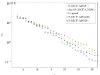 Peter Benner, Patrick Kürschner and Jens Saak have published the first preprint in 2012 in the MPIMD preprint series. The preprint is entitled "A Goal-Oriented Dual LRCF-ADI for Balanced Truncation".
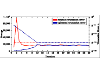 The CSC group published 3 new preprints in the last 5 days:
  I will use a research grant from the UJI in Castellon (Spain) for
a visit to the group of Enrique Quintana-Orti.
Together with Alfredo Remon i am planning to continue our work on GPU based
matrix equation solvers.On October 4th and 5th all members of the DFG Transregio SFB 96
Thermo-energetic design of machine tools meet at TU Dresden for their first general assembly. During the 2 days workshop the 19 participating subprojects present their current and future work for the first year of existence. Peter Benner, Norman Lang and Jens Saak will join as responsible for project A06 Model Order Reduction for Thermo-Elastic Assembly Group Models and establish contacts to the persons in charge of the other simulation projects.The GAMM Workshop 2011 on Applied and Numerical Linear Algebra with Special Emphasis on Model Reduction will be held in Bremen on 22 and 23 September 2011. Peter Benner is member of the organizing committee. Tobias Breiten, Patrick Kürschner, Thomas Mach, Jens Saak, and André Schneider present their work in contributed talks. The workshop is followed by a special colloquium celebrating the 60th birthday of Angelika Bunse-Gerstner.
I will use a research grant from the UJI in Castellon (Spain) for
a visit to the group of Enrique Quintana-Orti.
Together with Alfredo Remon i am planning to continue our work on GPU based
matrix equation solvers.On October 4th and 5th all members of the DFG Transregio SFB 96
Thermo-energetic design of machine tools meet at TU Dresden for their first general assembly. During the 2 days workshop the 19 participating subprojects present their current and future work for the first year of existence. Peter Benner, Norman Lang and Jens Saak will join as responsible for project A06 Model Order Reduction for Thermo-Elastic Assembly Group Models and establish contacts to the persons in charge of the other simulation projects.The GAMM Workshop 2011 on Applied and Numerical Linear Algebra with Special Emphasis on Model Reduction will be held in Bremen on 22 and 23 September 2011. Peter Benner is member of the organizing committee. Tobias Breiten, Patrick Kürschner, Thomas Mach, Jens Saak, and André Schneider present their work in contributed talks. The workshop is followed by a special colloquium celebrating the 60th birthday of Angelika Bunse-Gerstner. The 17th ILAS Conference will be held in Braunschweig from 22 to 26 august 2011. Peter Benner is member of the organizing committee. Jens Saak and Alfredo Remón Gómez (Universitat Jaume I, Castelló de la Plana) are organizing an YR minisymposium on Parallel Computing in Numerical Linear Algebra. Further several group members will give contributed talks.
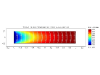 Regulator based tracking control of a parabolic partial
differential equation under control constraintsextension and maintenance of the research groups web site. Contact: Jens Saak. This news entry is expired.
Regulator based tracking control of a parabolic partial
differential equation under control constraintsextension and maintenance of the research groups web site. Contact: Jens Saak. This news entry is expired. Further development of the software library M.E.S.S. Contact: Martin Köhler. This news entry is expired.Deutsche Forschungs Gemeinschaft (DFG) sets up new Transregio SFB 96 Thermo-Energetic Design of Machine Tools at Technical Universities Dresden and Chemnitz, as well as RWTH Aachen. The Chemnitz part of our research group is participating with project A06 Model Order Reduction for thermo-elastic assembly group models.
 Saturday, 28th May 2011, 6.00 a.m. to 1.00 p.m., Max Planck Institute MagdeburgNewsropa.de have an article on our new Linux-cluster otto. Further the Volksstimme have an article in their print-version on otto.
 Jens Saak is invited to J. J. Strossmayer University of Osijek to give a lecture on Algebraic Riccati Equations from May 2 to 06. Additionally he give a colloquiums talk at 5th May on Numerical Solution of Linear Quadratic Regulator Problems under PDE Constraints.
 CSC research group met the first time for a research group weekend workshop in Clausthal Zellerfeld in the Harz Mountains from April 7th to April 11th. Besides 14 discussion forums about problems of the recent group research a visit in a local glass factory, a BBQ, a hike, a campfire, and sports (Bildungsstätte der Sportjugend Niedersachsen) was scheduled.
 Hermann Mena (ENP Quito, Ecuador) is visiting the MPI Magdeburg again. Together with René Schneider (TU Chemitz) we will continue the cooperation in the project aerial-spray-drift.
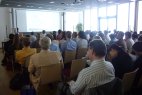
 Peter Benner, Martin Heß, Jens Saak, Judith Schneider und André Schneider join the Workshop on Model Order Reduction in Optimization and Control with PDEs from 26th to 28th January 2011 at WIAS in Berlin.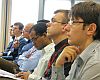
 The new Group Webpage is almost complete. We have copied large parts of the old MiIT-Webpage, neverless some parts are still under construction. If you do not find the informations you search, do not hesitate to ask us!